In a warehouse, pedestrians and forklift trucks share the same floor. Impact protection shields racking and walls from strikes, but what protects people from trucks is a clear boundary between their routes. Warehouse pedestrian guardrails create that boundary. This article covers where to install them and how to choose the type. We write about protecting racking, corners and machinery in our article on types of industrial impact protection.
Where guardrails are installed
- Along pedestrian walkways – the guardrail separates the walkway from the truck route and stops pedestrians taking shortcuts across it.
- At exits from rooms and offices – a worker coming through a door doesn’t step straight into the path of an approaching truck.
- Around machinery – the guardrail marks out the machine’s working zone, which unauthorised people must not enter.
- On mezzanines and platforms – the guardrail acts as a handrail at height, where people walk regularly.
- In surface and underground car parks – it separates the footway from the parking bays and protects equipment.
Types of guardrail
The SONTO range includes four types of warehouse pedestrian guardrail, all made of steel:
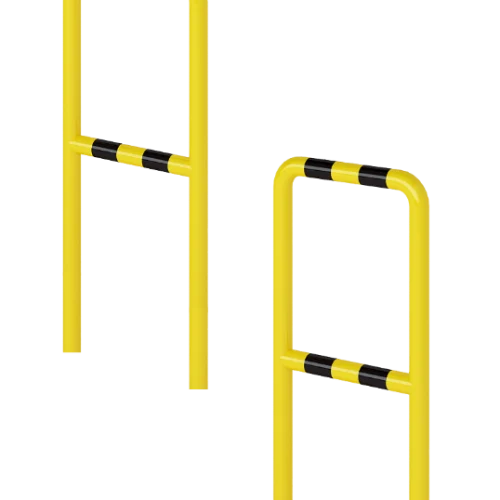
- Guardrail with cross bar – 110 cm high, 200 and 50 cm segments, galvanised. The short segment closes the gap between a column and a wall.
- Guardrail with vertical infill bars, 200 cm – the vertical bars add rigidity and close the gap below the handrail.
- Modular handrail system, 150 cm – made of Ø48,3 mm tube, easy to reposition when the building layout changes.
- Walkway guardrail, 110 cm – basic segregation for walkways, priced individually.
Crossing points in a guardrail line
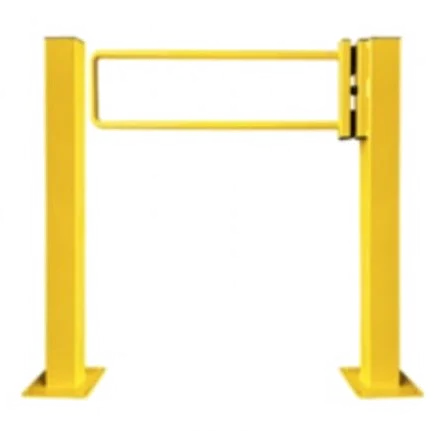
A guardrail line needs gaps where pedestrians cross to the other side. An open gap, however, invites people to walk straight out into the truck route. The answer is a self-closing safety gate, 800, 1000 or 1200 mm wide. The gate is steel, powder coated in yellow and black stripes. Pedestrians have to open it, so they stop before stepping onto the truck route, and drivers can see from a distance where the crossing is.
Guardrail or impact protection
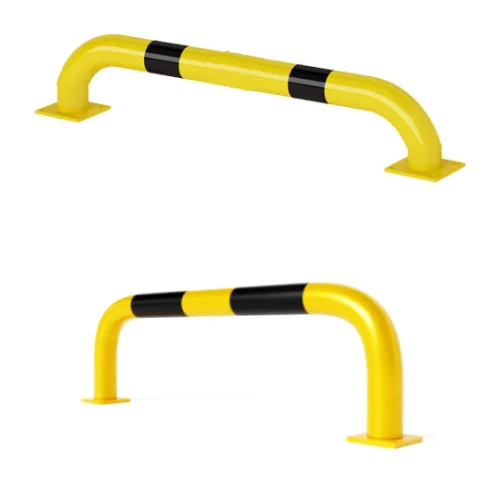
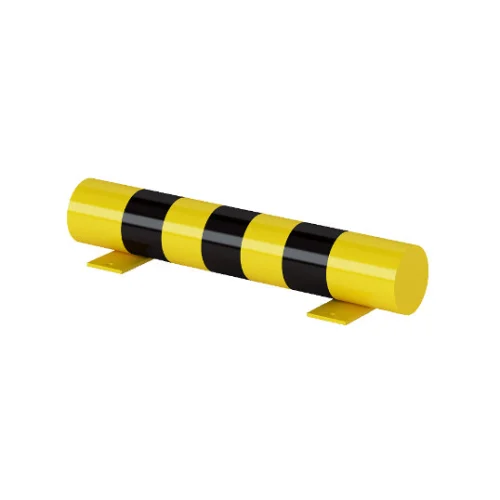
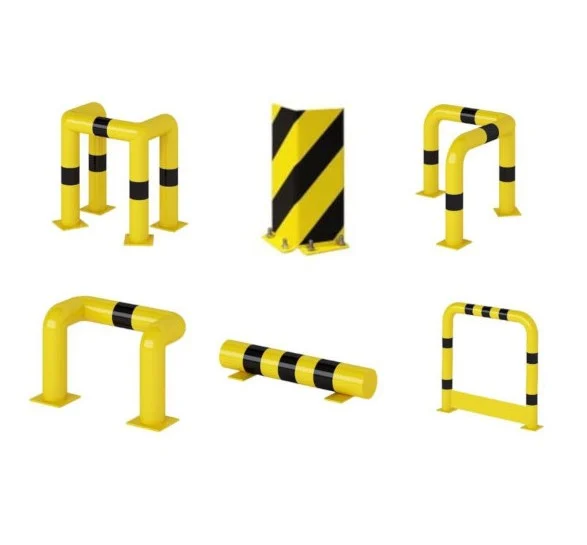
These are two different jobs. A guardrail marks a boundary and guides pedestrians. It isn’t designed to take the impact of a loaded truck. An impact barrier made of heavy-wall tube sits at floor level and takes the hit. Where a walkway runs right next to a truck route, both are used. A bumper barrier is fitted low at floor level to stop the wheels, with a guardrail above or behind it to guide pedestrians.
Installation: bolt-down or concrete-in
The guardrail with cross bar can be bolted to the floor or set in concrete. The bolt-down version is easy to move when the warehouse layout changes. The concrete-in version is more stable and suits areas where the route layout stays the same. Before anchoring, check the slab thickness and where services run in the floor.
Visibility
Yellow with black stripes is the standard warehouse marking. The self-closing gates and impact barriers come in these colours, while the guardrails are galvanised. Anything clearly visible from a distance also works as a warning sign, so drivers find it easier to steer around. It is worth adding painted floor lines along walkways to complement the guardrail line.