


Razor Wire & Barbed Wire
Razor Wire & Barbed Wire for fence tops and free-standing barriers: concertina, flat wrap, spiral and straight razor wire, barbed wire and brackets.
-

Barbed Wire 2 mm
Price range: 36,58 € through 61,78 € excl. 23% VAT Price range: 44,99 € through 75,99 € incl. 23% VATSelect options This product has multiple variants. The options may be chosen on the product page -

Barbed Wire 2,5 mm
Price range: 32,51 € through 58,53 € excl. 23% VAT Price range: 39,99 € through 71,99 € incl. 23% VATSelect options This product has multiple variants. The options may be chosen on the product page -

Concertina Razor Wire
Price range: 27,63 € through 265,03 € excl. 23% VAT Price range: 33,99 € through 325,99 € incl. 23% VATSelect options This product has multiple variants. The options may be chosen on the product page -
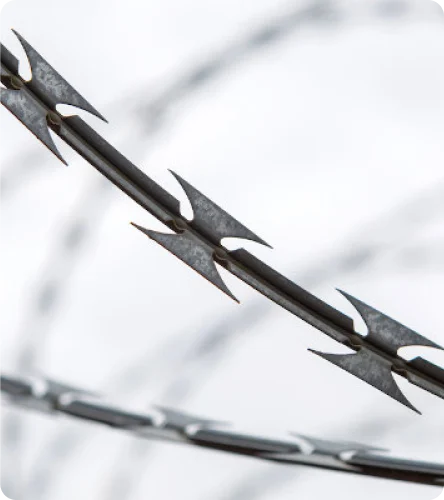
Flat Wrap Razor Wire
Price range: 53,65 € through 73,16 € excl. 23% VAT Price range: 65,99 € through 89,99 € incl. 23% VATSelect options This product has multiple variants. The options may be chosen on the product page -

Razor Wire 200 m Roll
61,78 € excl. 23% VAT75,99 € incl. 23% VAT -
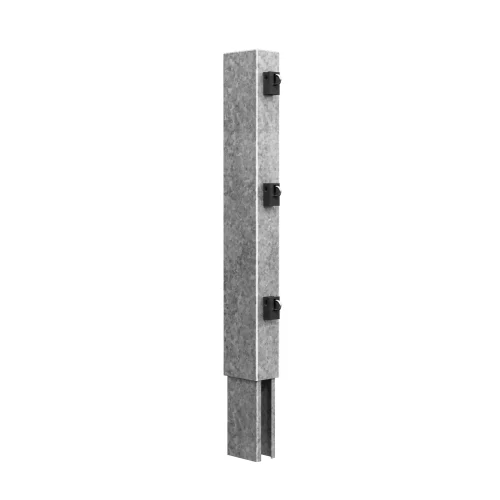
Razor Wire Bracket
Price range: 8,93 € through 13,00 € excl. 23% VAT Price range: 10,99 € through 15,99 € incl. 23% VATSelect options This product has multiple variants. The options may be chosen on the product page -
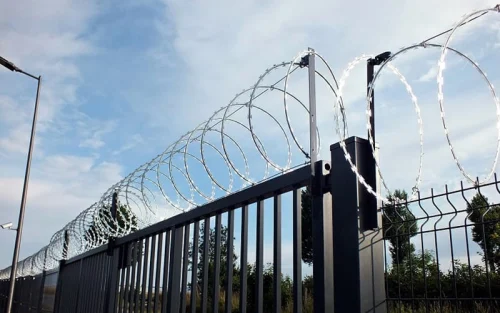
Spiral Razor Wire
Price range: 21,13 € through 57,72 € excl. 23% VAT Price range: 25,99 € through 70,99 € incl. 23% VATSelect options This product has multiple variants. The options may be chosen on the product page -
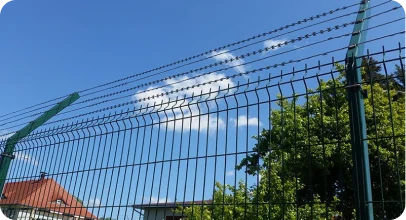
Straight Razor Wire
61,78 € excl. 23% VAT75,99 € incl. 23% VATSelect options This product has multiple variants. The options may be chosen on the product page -
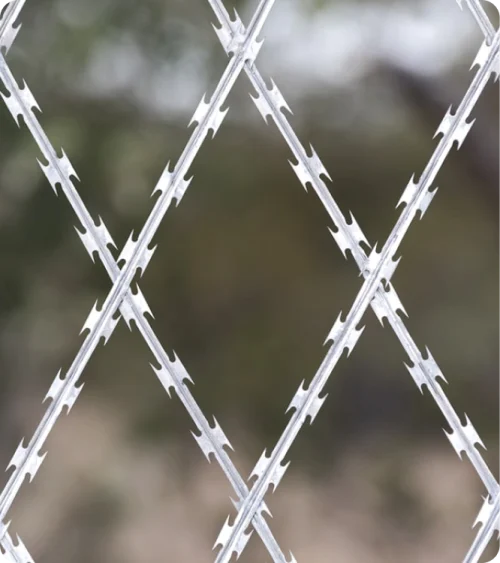
Welded Razor Mesh Panel 6000×2100 mm
130,89 € excl. 23% VAT160,99 € incl. 23% VAT
Razor Wire & Barbed Wire
Razor Wire & Barbed Wire for perimeter protection
This category covers the products that make a fence harder to climb or cut through: barbed wire, several forms of razor wire, welded razor mesh panels and the brackets that carry them along the top of a fence. You can fit them to an existing fence or wall, or lay them out as a separate obstacle on open ground. All of them are made for permanent outdoor use and resist the weather.
Barbed wire and razor wire work in different ways. Barbed wire consists of two twisted steel wires carrying short barbs at regular intervals. Razor wire uses a thin steel tape punched into sharp, razor-like blades and fixed to a galvanised core wire. The blades sit closer together and are harder to cut, so razor wire is the usual choice where the risk of intrusion is higher.
Razor wire types: concertina, flat wrap, spiral and straight
The shape of the coil decides how much depth the barrier has and how it is installed. Straight razor wire runs in a line, much like barbed wire, and follows an existing fence closely. Concertina and spiral coils open into a cylinder. Flat wrap razor wire consists of overlapping loops held in one plane, so the barrier stays compact and tidy. The main parameters of each type:
- Concertina razor wire: coil diameters of 450, 730 and 980 mm, 54 coils per unit, joined with 3 or 5 metal clips
- Spiral razor wire: diameters of 300 and 450 mm, installed without clips, extending to about 6 m or 8–9 m
- Flat wrap razor wire: diameters of 500, 700 and 900 mm, one module extends to 8–15 m
- Straight razor wire: blades every 10–15 mm, rolls of 100, 150, 200 and 250 m
- Razor wire in a 200 m roll: coil diameter 300–450 mm, zinc coating of at least 275 g/m²
- Welded razor mesh panels: 6000×2100 mm sheets with a 300×150 mm mesh
Barbed wire: two gauges with Z65 zinc coating
Both barbed wires in the range are double strand: two core wires twisted together hold the barbs in place. The zinc coating is Z65 at 80 g/m². The 2 mm wire has 20 mm barbs every 102 mm and comes in 125 m and 250 m rolls. The 2.5 mm wire has longer barbs of about 25 mm, spaced every 100 mm, comes in 90 m and 180 m rolls and takes higher mechanical loads.
Barbed wire protects industrial and storage sites, and it is just as common on farms, where it fences pasture, keeps livestock in and protects crops from wild animals. It can stand alone on posts or run above an existing fence.
Where razor and barbed wire are used
Flat wrap razor wire and welded razor mesh panels combine well with CCTV, intrusion sensors and security lighting: the physical barrier slows an intruder down, and the electronics report the attempt. Razor and barbed wire go where a standard fence alone does not give enough protection. Typical sites:
- industrial plants and critical infrastructure, for example power stations and sewage treatment works
- military sites, training areas and prisons
- airports and other sites with a raised security level
- storage yards and outdoor warehouses
- construction sites that need protection against theft and vandalism for the duration of the works
Brackets, tensioning wire and clips
On top of a fence, barbed wire brackets and extension arms carry the wire along the upper edge. They are made from 30×30×3 mm galvanised steel profile and come as straight, angled, double-arm V and double-arm Y brackets, plus a mini bracket and a bracket on an angle section. Versions with a flat foot plate fix to walls and concrete.
Concertina and spiral coils keep their shape when they are tensioned along a line wire. Tensioning wire comes in 3 mm and 3.5 mm diameters, and galvanised steel wire rope in a 6×7 construction is an alternative. Joints are made with galvanised sheet metal clips, stainless steel wire clips or PZ clips, closed with manual, automatic or pneumatic clip tools. Cut-resistant gloves belong on every installation.
Choosing razor or barbed wire: depth, environment and blades
Before choosing barbed and razor wire for a site, answer three questions: how much space can the barrier occupy, how aggressive is the environment, and what level of protection does the site need? Concertina gives the most depth. Flat wrap is more compact and looks more orderly, which suits sites that need effective but less aggressive-looking protection. Straight razor wire and barbed wire adapt most easily to fences that are already in place.
Galvanised steel is the standard material. For humid or salt-laden locations, concertina, spiral and straight razor wire, the 200 m razor wire roll and welded razor mesh panels are also available in stainless steel. Concertina comes with smooth 22 mm blades as standard; a premium version has serrated blades 25 mm or 35 mm long, which are even harder to get past.
Frequently asked questions
What is the difference between concertina and spiral razor wire?
Concertina coils are joined with metal clips, so the extended coil forms a deep, stable barrier. Spiral razor wire is the simpler and lighter version of the same idea: it is installed without clips and extends to about 6 m (300 mm coil) or 8–9 m (450 mm coil).
Is razor wire the same as barbed wire?
No. Barbed wire carries barbs made of twisted wire. Razor wire carries a steel tape with razor-like blades on a galvanised core wire, which makes it much harder to cut or climb over and gives a higher level of protection.
How is razor or barbed wire fixed to a fence?
Most often on barbed wire brackets fixed to the fence posts, or on double-arm V and Y brackets. It can also be fitted directly to the fence or laid on the ground as a free-standing obstacle. Tensioning wire and clips hold the coils in shape.
Which material suits coastal or very humid sites?
Stainless steel. Concertina, spiral and straight razor wire and welded razor mesh panels are available in stainless steel as well as galvanised steel.