


Welded Razor Mesh Panels
Welded Razor Mesh Panels 6000×2100 mm: bladed wires welded into a 300×150 mm mesh, galvanised or stainless, for high-security fences and walls.
-
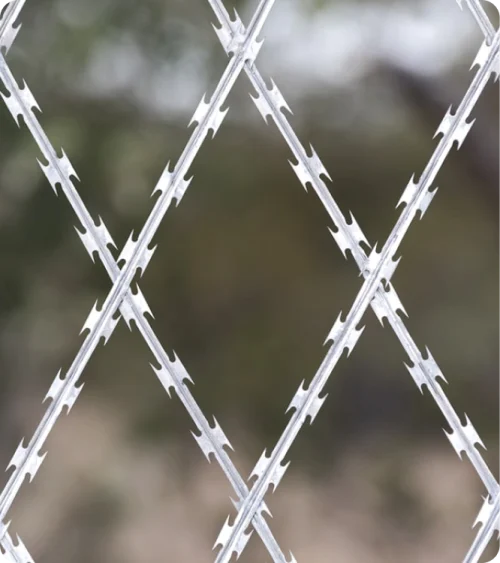
Welded Razor Mesh Panel 6000×2100 mm
130,89 € excl. 23% VAT160,99 € incl. 23% VAT
Welded Razor Mesh Panels
Welded Razor Mesh Panels: how they are made
A welded razor mesh panel is made from bladed wire: core wires carrying razor-like blades are laid at a set angle and welded at the crossing points. The result is a rigid sheet that resists cutting and bending. Its aggressive look deters intruders before they even attempt to cross. In the UK the same product is also known as razor mesh trellis.
The panels are made of galvanised or stainless steel, which protects them against corrosion and the weather. They work as a free-standing barrier or as an extra layer on an existing fence, often together with concertina razor wire.
Panel specification
Each panel covers 6000 mm in width and 2100 mm in height and weighs 17 kg. The mechanical strength of the wire is above 1700 N/mm², which makes the mesh hard to cut or bend. Parameters:
- Size: 6000×2100 mm (width × height)
- Mesh: 300×150 mm
- Core wire diameter: 2.5–3.0 mm
- Blade length: 22–25 mm
- Weight: 17 kg per panel
- Mechanical strength: above 1700 N/mm²
- Construction: welded, galvanised or stainless steel
Mounting razor mesh trellis on fences and walls
On mesh panel fences, Y or V supports hold the razor mesh at 45 degrees and add 45–60 cm to the total height of the barrier. Walls and concrete posts take L-type supports; concrete fences need dedicated mounting brackets. Galvanised mounting posts should have a wall thickness of at least 3 mm.
Joints are made with system clips closed by hydraulic crimping tools, which give connections a strength of up to 1500 N. Screw tensioners with stainless steel wire ropes keep the mesh taut. In polluted air, use fixings with a reinforced zinc coating of at least 85 micrometres; in highly corrosive places, A4 stainless steel fixings. Fixings can also be powder-coated to match the colour of the existing fence.
Where welded razor mesh is installed
Compared with barbed wire, razor mesh gives far more effective protection, and unlike ordinary fences or panel barriers it has a strong psychological effect. In prisons and industrial plants it often forms the core of the perimeter system, which can be reinforced with further elements. The installation kit covers clips, crimping tools, tensioners, turnbuckles, screws, tensioning wires and ropes, barbed wire and protective gloves.
Razor mesh goes where the perimeter needs a higher level of protection. At critical infrastructure sites it is often combined with tension and vibration sensors and thermal cameras, so any attempt to breach the fence is reported to the security centre at once. With good anti-corrosion coatings and regular checks of mesh tension, the panels can stay fully functional for up to 15 years. Typical sites:
- military installations, police stations, training grounds and airports
- prisons and industrial plants
- high-bay warehouses and logistics centres
- power stations, transformer substations and water intakes
Frequently asked questions
What size are the welded razor mesh panels?
Each panel is 6000 mm wide and 2100 mm high, with a 300×150 mm mesh, and weighs 17 kg.
Can razor mesh stand on its own?
Yes. It works as a free-standing barrier or as an additional layer on an existing fence or wall.
Can it be combined with concertina razor wire?
Yes. Welded razor mesh panels are often installed together with concertina razor wire.
How long do the panels last?
With good anti-corrosion coatings and regular checks of tension and fixings, welded razor mesh can stay fully functional for up to 15 years.