


Wheel Guides
Wheel Guides for loading bays: steel tubes fitted in pairs that steer reversing lorries straight to the dock and keep them off doors and walls.
-
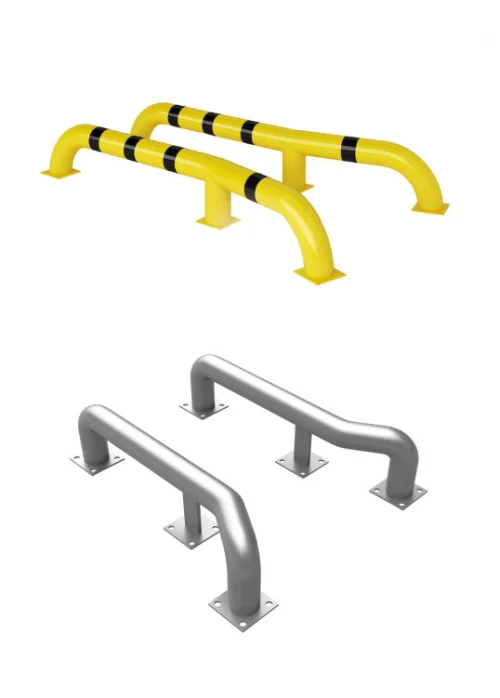
HGV Wheel Guide
Price range: 126,01 € through 221,13 € excl. 23% VAT Price range: 154,99 € through 271,99 € incl. 23% VATSelect options This product has multiple variants. The options may be chosen on the product page
Wheel Guides
Wheel Guides at the loading dock: how they work
Reversing onto a loading dock is a precision job, and a small misjudgement ends in a damaged door, wall or dock edge. Wheel Guides give the driver a physical track. Two steel tubes are fixed to the ground, one on each side of the bay, and they steer the wheels onto the correct line as the vehicle backs in. The driver no longer has to pull forward and correct the position several times.
Because the guides are always installed in pairs, the vehicle ends up centred on the door. Fewer knocks mean fewer repairs to doors, docks and facades, and shorter manoeuvres speed up loading and unloading. The guides work at warehouse docks and on open loading yards alike.
HGV wheel guides: choosing the tube diameter
The tube diameter follows the vehicles that use the bay. A larger diameter resists harder impacts and is easier for the driver to see, which adds to safety. The Ø159 mm version is 300 mm high. Three diameters are available, each matched to a class of vehicle:
- Ø76.1 mm for light vans,
- Ø114.3 mm for standard lorries,
- Ø159 mm, the strongest version, for HGVs and articulated lorries.
Loading bay wheel guides: finish and fixing
Loading bay wheel guides are made of structural steel and protected against corrosion in one of two ways. The galvanised version withstands harsh weather and suits open yards. The powder-coated version in yellow RAL 1003 with black reflective film stripes stands out for the driver even from a distance. Both finishes extend service life.
The guides are either bolted to the ground on solid mounting plates or concreted into a foundation of sufficient depth. The spacing between the two guides must match the width of the vehicles using the bay, and the angle of the guides helps lead the wheels smoothly. Length is chosen to suit the bay: shorter guides for narrow docks, longer ones for wide loading areas where the wheels need guiding over a longer distance.
What a guided dock gains
With every vehicle placed accurately, loading can be organised more efficiently and manoeuvring areas can be smaller, which frees space around the warehouse. Traffic flows more smoothly, and less experienced drivers gain the most from the clear guidance. Together with dock signalling and other impact protection, wheel guides create an orderly manoeuvring zone that benefits both drivers and logistics staff.
Frequently asked questions
Which diameter suits HGVs?
The Ø159 mm version is the strongest and is intended for HGVs. Standard lorries use Ø114.3 mm and light vans Ø76.1 mm.
How many wheel guides does one bay need?
Two. Wheel guides are installed in pairs, one on each side of the bay, so the vehicle is centred on the door.
Galvanised or powder coated?
Galvanised guides are the more corrosion-resistant choice for outdoor yards. Powder coating in yellow RAL 1003 with black reflective film gives the best visibility.
How are wheel guides fixed?
They are bolted down on mounting plates or concreted into a foundation of sufficient depth.