


Forecourt Barriers
Forecourt Barriers in Ø102 mm steel tube, galvanised and yellow-black: they protect fuel dispensers from vehicles pulling up to the pump.
-
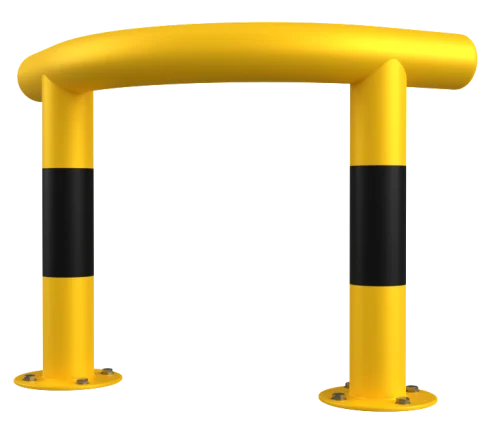
Forecourt Barrier
Price range: 392,67 € through 418,69 € excl. 23% VAT Price range: 482,99 € through 514,99 € incl. 23% VATSelect options This product has multiple variants. The options may be chosen on the product page
Forecourt Barriers
Forecourt Barriers: protecting the fuel dispenser
On a petrol station forecourt, vehicles pull up right next to the dispensers. A steel barrier takes the force of an accidental knock, limits the damage and keeps the pump in service. That improves safety for customers and staff, avoids expensive repairs and keeps the station running in an orderly way.
Which model fits depends on the station layout, the type of equipment and the volume of traffic. The Forecourt Barrier in the shop is made of Ø102 mm steel tube and comes in four versions: frames of 70×70 cm and 100×100 cm, and versions 75 cm and 100 cm high.
Shapes and dimensions
SONTO designs several shapes for different dispensers and different amounts of space. The standard height of 75 cm has proved itself in practice: it protects effectively without getting in the way of refuelling. For larger stations, different barrier types can be combined into one modular system tailored to the needs of a station network.
- U-shaped frames of 100×100 cm or 70×70 cm that surround the dispenser on three sides and take impacts from several directions,
- straight one-piece barriers 100 cm wide for the front of the dispenser, with classic or rounded corners,
- semicircular barriers in various radii that spread the force of an impact where space is tight and traffic must keep flowing.
Fuel pump protection built for the forecourt: finish and fixing
A forecourt is full of moisture, fuel and dust, so corrosion protection is standard. Every barrier is made of structural steel, galvanised and then powder coated in yellow and black. The colours are visible from every side, even in poor light or bad weather, and additional reflective elements improve visibility after dark. The smooth surface does not hold dirt and is quick to clean.
The barrier is fixed with anchors or set in concrete, depending on the construction of the surface and the expected loads. Both methods give high resistance to damage in the daily life of a station. Damaged elements can be replaced quickly, without interrupting work on the forecourt.
Other points worth protecting on a forecourt
Dispensers are not the only exposed items. Pillars, columns and building corners are also at risk, and corner protectors and bumper barriers from the same range cover them. Payment terminals and control panels are sensitive to mechanical damage and should be shielded in heavily used areas. A well-planned protection system secures the whole service area and helps organise traffic on site.
Frequently asked questions
How high is a forecourt barrier?
The standard height is 75 cm, which protects without hindering refuelling. A 100 cm high version is also available.
Which frame sizes are available?
The frames come in 70×70 cm and 100×100 cm to suit the size of the dispenser.
What tube diameter is used?
The Forecourt Barrier is made of Ø102 mm steel tube.
Will the barrier cope with fuel and moisture?
Yes. The steel is galvanised and powder coated, which protects it against moisture, fuel and dust on the forecourt.