


Hoop Barriers
Hoop Barriers in types U2, U3 and U4: steel hoops that protect columns, posts, machines and corners from forklifts on three sides.
-
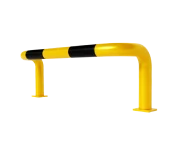
Hoop Barrier
Price range: 79,67 € through 172,35 € excl. 23% VAT Price range: 97,99 € through 211,99 € incl. 23% VATSelect options This product has multiple variants. The options may be chosen on the product page
Hoop Barriers
Hoop Barriers: three-sided protection for posts, machines and corners
A U-shaped steel hoop wraps around the object it protects and meets an impact from the front and both sides. Hoop Barriers, also called hooped barriers, safeguard columns, posts, machines and equipment against forklifts and transport vehicles. In warehouses they are often installed around high-bay racking, and at entrance doors they cut the risk of costly repairs.
In production plants the hoops mark safety zones around process lines. They also protect building corners in busy areas, where trucks turning in tight spaces could damage walls, and they shield pipes, hydrants and service lines so these stay intact after an accidental knock.
Types U2, U3 and U4 and their sizes
The range has three types, matched to traffic intensity. The hoops are made of steel tube with a diameter of 60.3 or 76.1 mm.
- U2: a light, economical guard for sites with moderate traffic; 50x30x30 cm for small posts, 100x30x80 cm for larger structures,
- U3: the same dimensions as U2 with a reinforced construction that absorbs impact energy better,
- U4: 40x40x110 cm or 50x50x110 cm for loading zones and intensive traffic; the extra height protects against impacts from tall vehicles.
Galvanised steel hoop barrier or powder-coated finish
Each model is powder coated in bright yellow RAL 1003 with black reflective film stripes, which raises visibility and marks the protected zone at once. In damp environments or outdoors, SONTO recommends the galvanised version: a galvanised steel hoop barrier gets effective corrosion protection and a longer service life.
Thanks to its shape, the hoop absorbs the force of an impact and prevents more serious damage. Choose the type by the character of the traffic and by what needs protecting.
Fitting a bolt down hoop barrier
The hoops are bolted directly to the floor and become a permanent part of the building. The best base is concrete of class C20/25 at least 15 cm thick. In reinforced industrial floors, expansion anchors at least 100 mm long are used; where the floor has limited load-bearing capacity, chemical anchors spread the forces better and hold more securely.
Mark the positions precisely first. When hoops form a protective run, leave gaps of 10 to 15 cm between them. Drill the holes with the right bit, since oversized holes weaken the anchors, and tighten the anchors to a torque of 50 to 70 Nm. Typical mistakes are a barrier that is not level, anchors that are too short and dust left in holes before chemical anchors are used; each of them weakens the fixing.
Frequently asked questions
What is the difference between U2, U3 and U4?
U2 is the light version for moderate traffic. U3 has the same dimensions but a reinforced construction. U4 is taller, at 110 cm, for loading zones and intensive traffic.
Which sizes are available?
U2 and U3 come in 50x30x30 cm and 100x30x80 cm; U4 in 40x40x110 cm and 50x50x110 cm.
Is there a galvanised version for outdoor use?
Yes. For damp environments and outdoors, the galvanised version is recommended for its corrosion protection.
What floor is needed for installation?
Concrete of class C20/25, at least 15 cm thick, with expansion anchors at least 100 mm long or chemical anchors.