


Timber Crash Rails
Timber Crash Rails for warehouses and industrial units: 75×200 mm timber rails that absorb forklift impacts and protect walls, columns and vehicles.
-

End Bracket for Timber Crash Rail
31,70 € excl. 23% VAT38,99 € incl. 23% VAT -
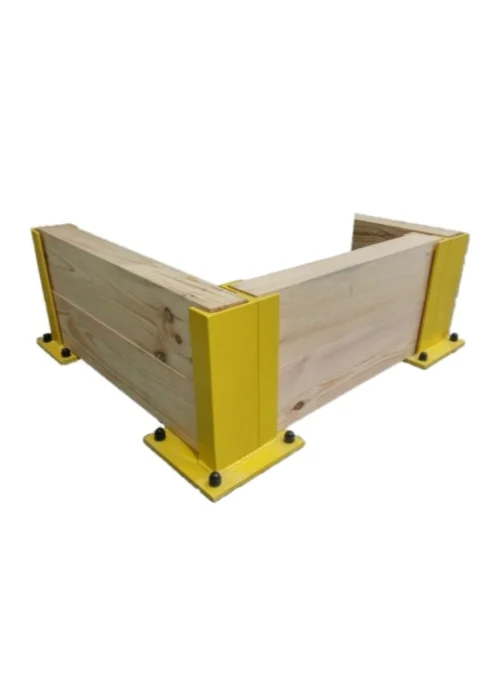
Timber Crash Rail
191,86 € excl. 23% VAT235,99 € incl. 23% VATSelect options This product has multiple variants. The options may be chosen on the product page -
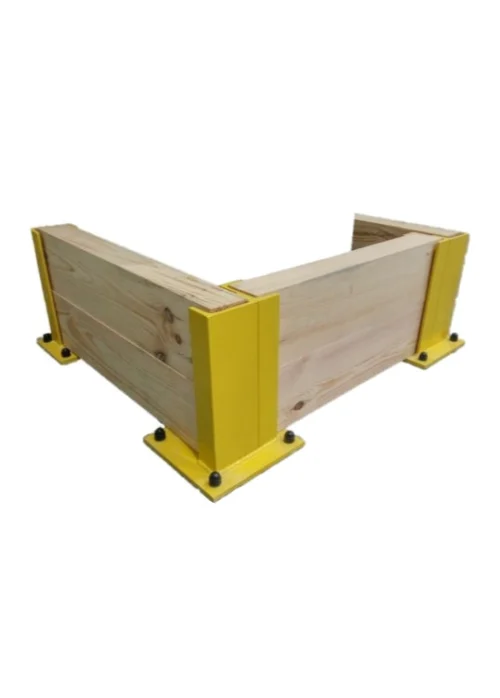
Timber Rail 75×200 mm
31,70 € excl. 23% VAT38,99 € incl. 23% VAT
Timber Crash Rails
Timber Crash Rails: why timber absorbs impacts
Timber Crash Rails use the natural springiness of wood. A solid rail takes the energy of an impact from a forklift or other transport vehicle and absorbs it, which reduces damage to the building and to the vehicle. Compared with steel, timber absorbs the force better, is simpler to replace and is gentler on trucks that run into it.
That matters in intensively used warehouses where forklifts reach speeds of up to 20 km/h. The rails are made of strong timber that copes with heavy dynamic loads, and they are impregnated against moisture, mould and other factors that shorten service life. In UK catalogues this kind of wall protection is also sold as bump rails.
Timber rail, complete crash rail and end bracket
The system is built from a few parts, which you can order separately or as a complete unit. The standard timber rail measures 75×200 mm in cross-section and 1200 mm in length and is the most frequently chosen option. SONTO can also adapt the length and other parameters to individual requirements.
- Timber Rail 75×200 mm: a single rail, 1200 mm long, for building a new run or replacing a damaged section.
- Timber Crash Rail: a ready unit with 75 x 200 mm rails, 1200 mm long, available single or double.
- End Bracket for Timber Crash Rail: a galvanised steel bracket for the end of the run.
Where timber crash rails protect the building
In industrial halls and warehouses, the main job of the rails is to protect walls, columns and other structural elements from forklifts and warehouse vehicles manoeuvring close by. In logistics centres and high-bay warehouses with heavy daily traffic, they also secure traffic routes and runs of racking.
At loading docks the rails cushion impacts from transport vehicles and protect both the building and the equipment. Around machines, technical installations and industrial equipment, they form a protective zone. Clearly separated work areas make space planning easier and reduce accidental collisions, and the natural look of timber fits well into an industrial interior.
Fixing and replacing damaged rails
Steel brackets allow fast fixing. SONTO makes them in three types: T brackets, the usual choice for walls and other vertical surfaces; reinforced H brackets for loading areas where vehicles manoeuvre with heavy loads; and C brackets, made from channel section, for corners and edges. The brackets are galvanised steel, which protects them from corrosion in industrial conditions.
When a rail is damaged, only that part is swapped, without dismantling the whole run. That saves time, shortens downtime in the warehouse and keeps maintenance costs down. The right bracket depends on where the rail is mounted and on the type of load it has to take.
Frequently asked questions
What size are the timber rails?
The standard rail is 75×200 mm in cross-section and 1200 mm long.
Why choose timber instead of steel?
Timber absorbs impact energy better, is easier to replace and is gentler on vehicles that hit it.
Is the timber protected against moisture?
Yes. The rails are impregnated against moisture and mould.
Is there a single and a double version?
Yes. The Timber Crash Rail is available single or double.