


Straight Razor Wire
Straight Razor Wire with blades every 10–15 mm, galvanised or stainless, in rolls of 100 to 250 m for fitting in lines along new or existing fences.
-
Straight Razor Wire
61,78 € excl. 23% VAT75,99 € incl. 23% VATSelect options This product has multiple variants. The options may be chosen on the product page
Straight Razor Wire
Straight Razor Wire: a blade tape on a core wire
Straight razor wire, also sold as razor barbed tape or single strand razor wire, is the linear form of razor wire. A steel tape 1.5 mm thick carries razor-like blades at intervals of 10–15 mm and is fixed to a core wire. Blade width varies with the model. The steel is galvanised carbon steel or, for sites exposed to aggressive weather, stainless steel.
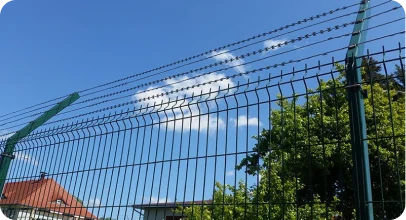
The wire is laid in a straight line, singly or in several parallel rows. That makes it easy to add to a fence that is already standing, and transport costs less than for concertina coils.
Roll lengths, wire diameters and security classes
The core wire is available in diameters from 1.5 mm to 3.0 mm. The 2.5 mm wire is the most popular size because it balances strength and cost well. Versions with a single or a double row of blades exist; the double row suits places that need a higher level of protection.
SONTO grades straight razor wire in security classes 2 to 4. The grading takes into account mechanical strength, cut resistance and the durability of the anti-corrosion coating; class 4 is intended for sites with the highest risk. Main parameters:
- Blade tape thickness: 1.5 mm
- Blade spacing: 10–15 mm
- Core wire diameter: 1.5–3.0 mm
- Security class: 2–4
- Roll length: 100 m, 150 m, 200 m or 250 m
- Material: galvanised carbon steel or stainless steel
Straight razor wire or concertina?
The difference lies in construction, installation and the level of protection. Single strand razor wire runs flat along the fence and adapts to what is already there. Concertina razor wire forms a three-dimensional cylinder of many coils joined with clips, which is much harder to get over. Concertina gives stronger physical protection and deterrence, but it needs more precise installation and dedicated tools and accessories.
Where razor barbed tape is installed
On industrial halls and warehouses, the wire is usually mounted on brackets set at 45 degrees. Loading zones and areas where valuable materials are stored often get a double row. Typical applications:
- military sites, training areas and prisons
- airports and critical infrastructure, in several rows and often combined with electronic detection systems
- housing estates and car parks, as a single line on top of a standard fence
- detached houses, at vulnerable points such as the back of the plot
- retail premises, together with CCTV
- construction sites, on temporary fencing that protects plant and materials from theft and vandalism
Posts, brackets and fixings
Galvanised steel posts with a diameter of at least 48 mm and a 2.5 mm wall are the usual base. For the highest security, rectangular 80×40 mm posts resist attempts to break them out. Brackets come in single and double versions, with the arm angle adjustable from 30 to 60 degrees.
Stainless steel spiral clips join lengths of wire, and caps and UV-resistant plastic ties protect the ends. A ratchet tensioner, reinforced pliers and cut-resistant gloves complete the installation kit. Mark the fence with clearly visible warning signs and check local regulations before you fit razor wire.
Frequently asked questions
What roll lengths are available?
Straight razor wire comes in rolls of 100 m, 150 m, 200 m and 250 m.
What is razor barbed tape?
Another name for straight razor wire: a steel tape with razor-like blades fixed to a core wire and installed in a straight line rather than as a coil.
Galvanised or stainless steel?
Galvanised carbon steel covers most sites. Choose stainless steel where the wire is exposed to aggressive weather conditions.
How many rows should I install?
A single line on top of a standard fence suits car parks and housing estates. Industrial loading zones, airports and critical infrastructure usually get two or more parallel rows.