


Bumper Barriers
Bumper Barriers in steel tube, 120 to 1100 mm high: continuous protection for racking, machines, walls and traffic routes in warehouses.
-
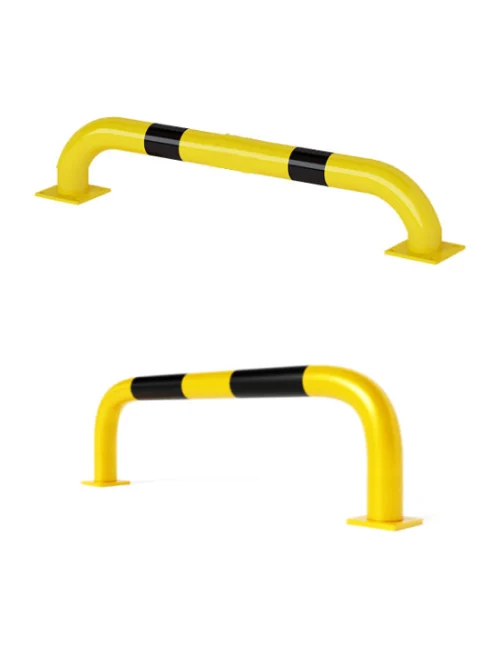
Bumper Barrier
Price range: 72,35 € through 156,09 € excl. 23% VAT Price range: 88,99 € through 191,99 € incl. 23% VATSelect options This product has multiple variants. The options may be chosen on the product page
Bumper Barriers
Bumper Barriers for warehouses, production halls and docks
Bumper Barriers form a continuous line of steel tube between vehicles and whatever they could hit. In warehouses they protect racking, machines and walls from forklift trucks, which reduces repair bills and operational downtime. Placed well, they also mark traffic routes, organise vehicle movement and lower the risk of accidents.
In loading areas with heavy lorry traffic, yellow barriers with black reflective stripes show drivers exactly where the manoeuvring limit is, sparing both vehicles and buildings. In production halls they shield workstations and machines from internal transport vehicles, and in car parks they mark traffic zones and protect walls and columns.
From low level bumper barrier to full-height rail
The rail comes in four heights, and the height decides what it protects. Segment lengths from 30 to 240 cm let you fit the line precisely to walls, racks and machine bases.
- 120 mm: a low level bumper barrier that guards the lower parts of machines and racking,
- 300 mm and 600 mm: mid-height rails that cover a larger area of walls and equipment,
- 1100 mm: a tall rail that protects entire traffic routes.
Tube diameter and finish
SONTO makes the rails from Ø60.3 mm steel tube, which is enough for most applications, or from Ø76.1 mm tube for very heavy impacts. Where heavy vehicles run all day, the larger diameter pays off; in zones with a lower risk of collision, the standard tube does the job.
Two finishes are available. Powder coating in yellow RAL 1003 with black reflective film stripes keeps the rail visible even in poor light. Galvanising gives corrosion resistance, which is essential in damp or chemically aggressive environments.
Installing bumper rails
Bumper rails are either bolted down or set in concrete. Bolt-down models are easy to install and to modify later. Concrete-in models go at least 30 cm deep and give maximum stability where damage is most likely. The concrete floor should be level, clean, free of cracks and at least class C20/25.
For bolt-down rails, holes are drilled with a hammer drill and fitted with expansion or chemical anchors, usually M10 or M12, spaced every 50 to 60 cm. Concrete-in rails are set in a 1:2:3 mix of cement, sand and gravel, which needs about 7 days to cure fully before the rail is ready for use. Longer runs are joined with connectors, corners are finished with corner protectors, and in damp zones galvanised parts with stainless anchors keep the whole line free of corrosion.
Frequently asked questions
Which heights are available?
The Bumper Barrier comes in heights of 120, 300, 600 and 1100 mm, with segment lengths from 30 to 240 cm.
Which tube diameter should I choose?
Ø60.3 mm is sufficient for most applications. For zones with heavy vehicles and strong impacts, choose Ø76.1 mm.
How deep does a concrete-in rail go?
At least 30 cm, set in a 1:2:3 mix of cement, sand and gravel. The concrete needs about 7 days to cure fully.
Is the rail suitable for damp areas?
Yes, in the galvanised version. Galvanising protects the steel in damp or chemically aggressive environments; use stainless anchors there as well.