“Temporary fencing” covers several different products: tall mesh panels, solid sheet steel hoarding, low-level excavation barriers, steel crowd control barriers and plastic barriers. Each has its own strengths and limitations. Below we set them out side by side.
Mesh temporary fencing
A 3500 × 2000 mm panel with a galvanised frame and wire mesh, set in feet and joined with couplers.
- Pros: light (approx. 10–14 kg), quick to install, cheap to transport, lets the wind through, meets the Polish 1,5 m height requirement.
- Cons: doesn’t stop dust or noise and doesn’t screen the site. Standard mesh can be climbed, so where theft is a risk, a tight-mesh panel (ANTICLIMB) or one with wires projecting above the frame (TEMPOFOR F2SM and F3) is the better choice.
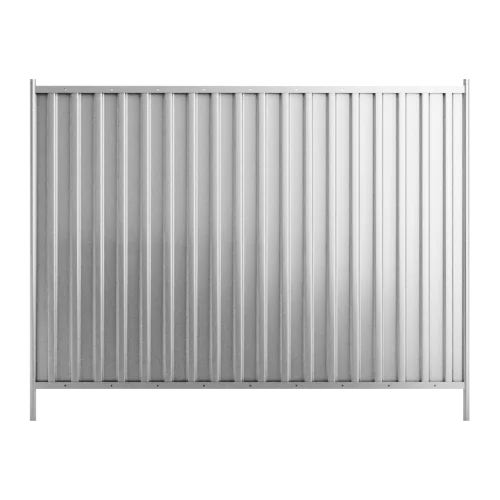
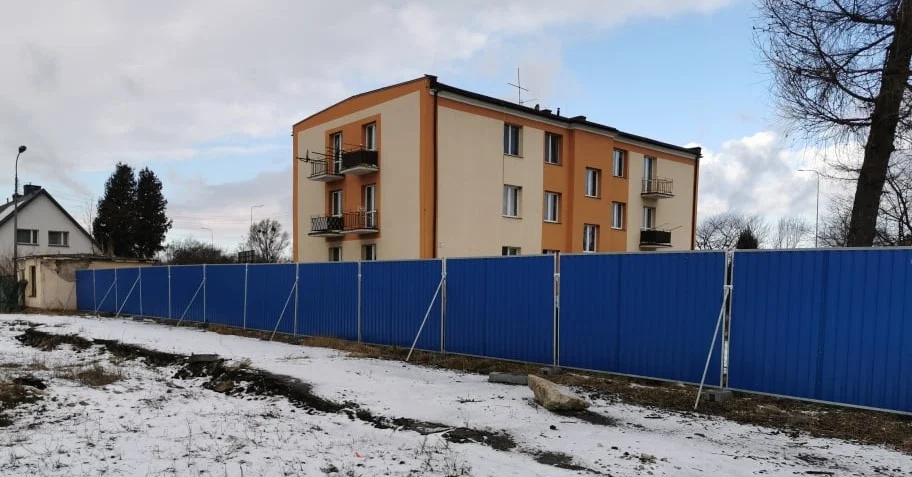
Steel hoarding
Box profile sheet panels 2,3 m, 2,9 m or 3 m wide, galvanised or painted in a RAL colour. There is also a half-mesh, half-solid version at 2345 × 2025 mm.
- Pros: screens the site, stops dust, reduces noise. Works well next to pavements, on demolition jobs and in city centres. The sheeting can carry information about the project.
- Cons: heavier and more expensive to transport. The solid surface catches the wind, so the line needs side stays.
Mesh panels with screening
A middle ground: standard mesh panels with a fabric screen. The screen can be put on and taken off at any time, so a see-through fence becomes a screen only when needed. At events, the screen hides the backstage area, for example. When choosing one, check whether the fabric is flame retardant. The limitation is the same as with steel hoarding: with a screen fitted, the line needs more stays.
Low-level mesh fencing
The LOW panel measures 3500 × 1100 mm. It fences off excavations, work zones inside the site and roadworks, where a tall fence is unnecessary but the area still has to be separated from its surroundings.
- Pros: light, quick to reposition, doesn’t block machine operators’ view.
- Cons: doesn’t meet the Polish 1,5 m requirement, so it can’t serve as the perimeter fence of a construction site.
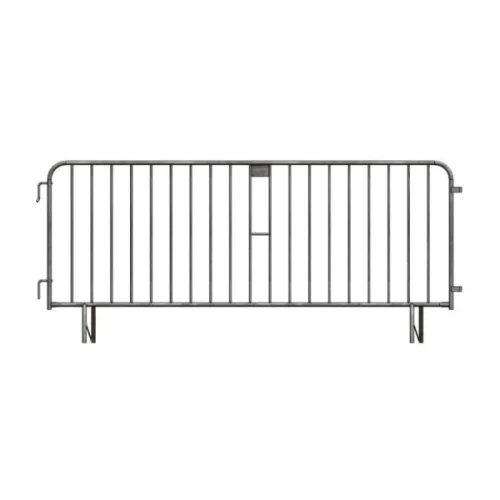
Steel crowd control barriers
Barriers approx. 1,1 m high and 2 to 2,6 m long, with a tubular frame and vertical infill bars, galvanised. For example, the 2,3 m oval barrier weighs 10,6 kg, and the 2,6 m Mannesmann HDG 14,2 kg.
- Pros: set up without tools, link together into a continuous line, good at guiding pedestrians at events, entrances and diversions.
- Cons: too low to secure a construction site against entry. They are for directing people, not for protecting a site.
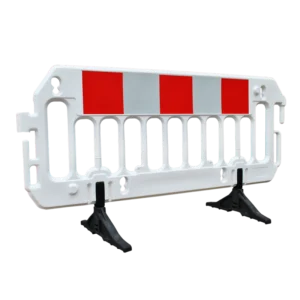
Plastic pedestrian barriers
Lightweight plastic barriers, often in warning colours. For example, the TOROS plastic traffic barrier (Polish class U-20) measures 2060 × 1060 × 50 mm and weighs 9,5 kg.
- Pros: very light, highly visible, rust-free. Suitable for roadworks and for fencing off work areas for short periods.
- Cons: won’t stop a determined intruder and can’t replace site perimeter fencing.
How to combine them
Most sites use several types at once. Mesh panels run around the perimeter, with steel hoarding along the pavement. Excavations inside the site are fenced off with low-level panels, and the pedestrian diversion is lined with crowd control barriers. All SONTO mesh panels use the same coupling system, so different types can be mixed in a single line.