


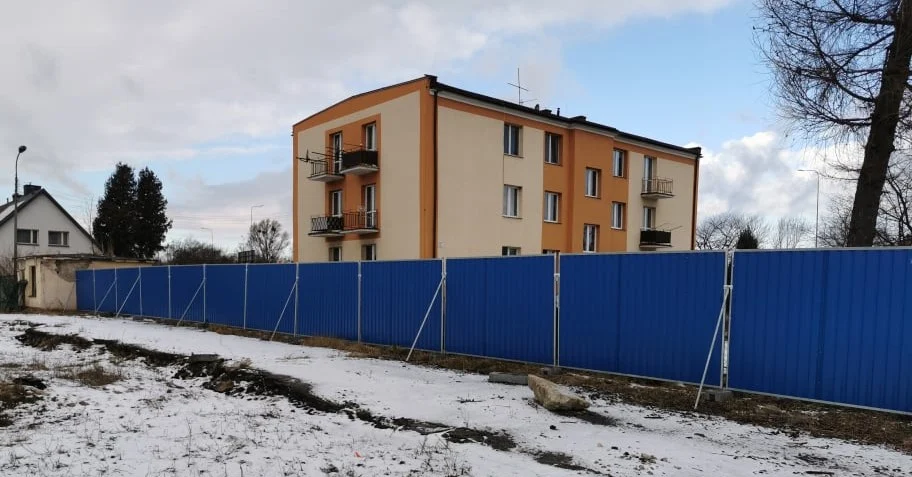
Temporary fencing essentially falls into two types: mesh and solid. The first is see-through, while the second has a sheet steel infill. The choice of fencing type largely depends on whether the developer wants to screen the site from view, or above all needs lightweight panels for repeated use across different locations. Our modern temporary fencing sections go up as a fence easily enough, but they can also be taken down just as easily so the panels can be reused for another site. The lighter the sections, the easier they are to transport and move. The advantage of box profile steel hoarding is that it screens the site completely and forms both an acoustic and a dust barrier. Its drawback, though, is its considerable weight. With these panels, side supports also need to be fitted to give the fencing reliable stability.
A standard mesh fence can be screened with tarpaulins at any time. Using this method, its character can be changed. A typical see-through fence can suddenly become a screening fence. Then no dust from the site can escape beyond it. A fire-retardant screen is an improved type of fencing cover. This product meets the relevant fire-retardancy standard. The panels produced are aimed at building sites, but event organisers are also happy to use them. If a section needs to block access to the backstage area, it’s better fitted with a screen.
Being able to move temporary fencing around freely is a huge advantage. It’s good when one product can be used again and again, since that saves a good deal of money. It also matters from an environmental point of view. An interesting type of fencing is the low mesh fence. When digging trenches, tall fencing isn’t needed. The same applies when carrying out roadworks. The Tempofor F2SM and Tempofor F3 models are cleverly designed. Vertical wires are also used above the level of the frame tube, making an erected fence even harder to breach. They form an additional row of anti-climb spikes.