
Site set-up has to be in place before works begin. In Poland, the requirements are set out in the Regulation of the Minister of Infrastructure of 6 February 2003 on health and safety during construction works. Paragraph 8 lists what must be ready before work starts: fencing and danger zones, roads and pedestrian walkways, power and water, washing, sanitary and welfare facilities, lighting, ventilation, a telephone connection and material storage areas. Below we go through these points one by one, with the specific dimensions from the Polish regulation.
Fencing and danger zones
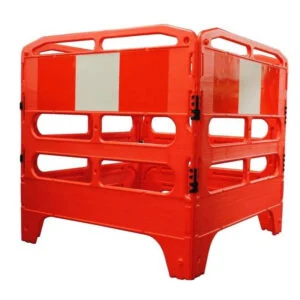
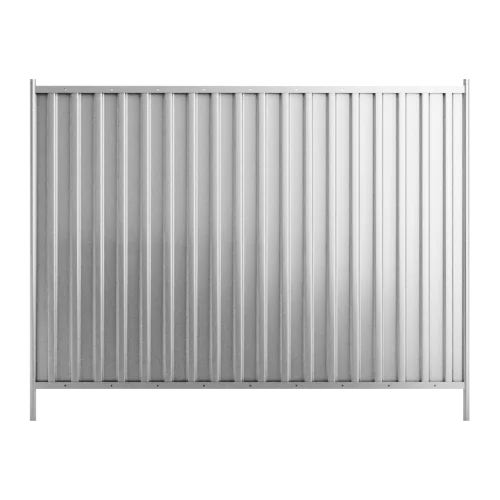
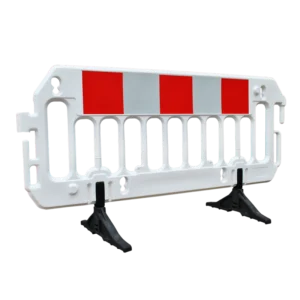
The regulation requires the site to be fenced or otherwise closed to unauthorised persons (§ 9). The fence must be at least 1,5 m high and must not endanger people (§ 10). Barrier tape does not meet this requirement. For how to choose the type of fence, see our article on choosing site fencing.
Inside the site, danger zones are fenced off as well, including the strip along the building where objects may fall. Walkways, vehicle routes and workstations within such a zone are covered with protective canopies (§ 20). The canopy sits at least 2,4 m above ground, slopes at 45° towards the hazard and projects at least 0,5 m beyond each side of the walkway (§ 22).
Roads, walkways and parking areas
- A pedestrian route must be at least 0,75 m wide for one-way traffic and 1,2 m wide for two-way traffic (§ 12).
- Routes for carts and wheelbarrows may have a maximum gradient of 4% for rail-mounted carts, 5% for trackless carts and 10% for wheelbarrows (§ 14).
- Walkways and danger zones are lit and marked with warning or prohibition signs (§ 17).
- Site vehicles have designated parking areas (§ 11).
- At least 15 m before a road passes under an overhead power line, marked goalposts are set up to show the maximum permitted vehicle height (§ 19).
Material storage
Storage areas are marked out, given a hard surface and drained (§ 23). Stacks are built on level ground so that nothing can topple or slide. Small-unit materials are stacked to a maximum height of 2 m, and bags in cross-laid layers, no more than 10 layers high (§ 26).
Two rules apply directly to fencing. A stack must be at least 0,75 m from the fence or buildings and 5 m from a permanent workstation (§ 26). Materials must not be leaned against fences either (§ 27). A temporary fence panel stands in its feet and isn’t designed to take sideways loads, so pallets leaning against it can bring down the whole line.
Hazardous substances such as paints, solvents and fuels are kept in the manufacturer’s containers and stored according to the manufacturer’s instructions. Information about them is displayed on warning signs in visible locations (§ 25).
Welfare and sanitary facilities
The site must have separate facilities: a changing room for work and protective clothing, a washroom, a canteen, a drying room and toilets (§ 30). If more than 20 people are working, the changing room and the canteen cannot share a room, and clothes lockers must be divided so that work clothing hangs separately from personal clothing (§ 31).
The Polish regulation allows two concessions. The contractor may use the client’s sanitary facilities if the contract provides for this (§ 32). Rooms in cabins may have a lower ceiling height than in an ordinary building (§ 33). On a small site, a welfare cabin and a portable toilet are therefore usually enough. On a large project, the compound is made up of many cabins, and its size depends on the number of workers.
Site information board and signs
On Polish sites, an information board at the entrance gives the details of the client, the contractor and the site manager, together with the building permit or notification number. Safety signs complete it: no entry for unauthorised persons, hard hats must be worn, hazard information. The easiest place to mount the board is on a fence panel next to the entrance gate.
The cost of non-compliance
In Poland, a labour inspector or a building control inspector can stop the works if they find serious breaches. A stoppage usually costs more than a cabin, a few fence panels and a set of signs. If an accident happens on a site without the required safety measures, the site manager may be held liable.